Disclaimer: I am not a doctor, medical professional, or healthcare provider. Everything shared in this post is based solely on my personal experience and research journey. Nothing in this article should be considered medical advice, diagnosis, or treatment. Always consult with a qualified healthcare professional before making decisions regarding your health. Any peptides discussed are intended for research purposes only and are not approved for human consumption.
Weeks 6–11: When Progress Started to Slow Down
Around Week 6, I hit my first noticeable plateau.
Up until that point, the weight had been coming off steadily, but I started noticing that the scale wasn't moving the way it had during the first five weeks. At the same time, life threw me a bit of a curveball. During the month of April, I ended up leaving my job, and my focus shifted almost entirely toward figuring out my next career move.
Because of that, my workouts took a backseat.
I stopped prioritizing exercise the way I had been earlier in my journey and spent most of my energy focusing on what was next professionally. Looking back, I've wondered if that played a role in the plateau. Maybe if I had continued working out consistently, the weight loss would have continued at the same pace. Or maybe not. It's impossible to know for sure, but it was definitely a variable that changed during this period.
Adding MOTS-C and GLOW
By Week 7, I decided to add MOTS-C and the GLOW stack to my routine.
At the time, my protocol looked like this:
I continued my weekly GLP-3 pin while introducing the new peptides to see how my body would respond.
My Experience With MOTS-C
For MOTS-C, I was taking 1 mg every three days.
One of the first things I noticed was an increase in energy. It wasn't an overwhelming stimulant-like feeling, but I definitely felt more motivated to move and be active. As the weeks went on, I found myself naturally wanting to get back into my workouts.
After spending several weeks focused on career decisions and neglecting exercise, that extra motivation was something I genuinely appreciated.
Out of everything I added during this phase, MOTS-C was probably the peptide I enjoyed the most. I simply felt better while taking it.
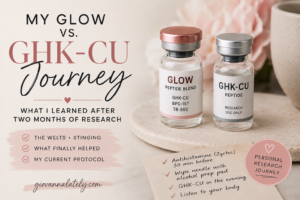
My Experience With GLOW
The GLOW peptide was a completely different experience.
The pin themselves weren't a problem. I would pin in the morning and go about my day as usual without any issues. I was taking 1 mg daily and initially thought everything was going smoothly.
What I found strange was that the irritation wouldn't start until later in the evening.
Several hours after pin, I would begin noticing stinging, itching, and small welts around the pin site. Since the reaction wasn't immediate, it felt even more unusual.
Because GLOW requires daily pin, dealing with that irritation every single night eventually became one of my least favorite parts of my routine.
I even tried diluting the peptide further to see if it would reduce the discomfort, but unfortunately, it didn't make much of a difference.
What's interesting is that one of my friends was running the exact same peptide and experienced none of these side effects. I've also seen some other researchers saying this peptide doesn't bother them at all.
That was a good reminder that everyone's body responds differently. What causes irritation for one person may be completely fine for someone else.
Changes to My Cycle
Another thing I noticed after adding MOTS-C and GLOW was a change in my cycle.
The week after my period ended, I experienced spotting and also noticed signs that I seemed to be ovulating much earlier than normal.
I can't say with certainty which peptide may have contributed to this, or if the timing was simply coincidental. However, it was something I observed shortly after introducing both MOTS-C and GLOW into my protocol.
Since this is a personal journal documenting my experience, I wanted to include it because it's something I haven't experienced regularly before.
The Dizziness
One side effect that started popping up occasionally was dizziness when standing up too quickly.
At first, I wasn't entirely sure what was causing it.
As GLP-3 continued doing its job, my food noise remained significantly reduced. I wasn't thinking about food nearly as often as I used to, which sounds great in theory, but it also meant I had to become more intentional about making sure I was eating enough.
Once I started paying closer attention to my nutrition, especially my protein intake, I noticed the dizziness improved quite a bit.
For me, it was a reminder that even when hunger signals decrease, my body still needs fuel.
Looking Back on Weeks 6–11
This phase of my journey felt less dramatic than the first few weeks, but it taught me a lot.
I learned that plateaus happen.
I learned that life stress can impact progress.
I learned that some peptides work wonderfully for me while others come with side effects that make them difficult to stick with.
Most importantly, I learned that when food noise disappears, I still need to be mindful about properly fueling my body.
Even though the scale wasn't moving as quickly as before, I was gathering valuable information about how my body responds, and that knowledge has been just as important as the weight loss itself.
The journey continued, but Weeks 6–11 were definitely a period of experimentation, adjustment, and learning.